Managing Multiple Staffing Agencies at One Event: A Practical Guide
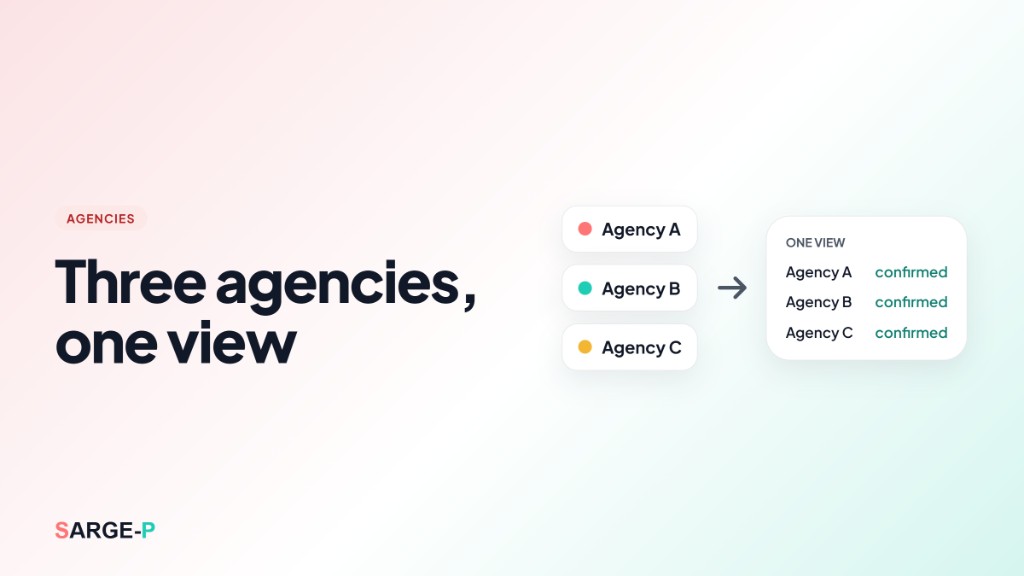
Three agencies, one event. Agency A sends a spreadsheet on Tuesday. Agency B updates a WhatsApp group on Thursday. Agency C sends a PDF on the morning of the event, and half the names have changed. By the time doors open, your supervisor is working from three lists and none of them quite match. Meanwhile, you still have your own staff to manage and payroll to get right.
If that sounds familiar, you're not doing anything wrong. Managing multiple staffing agencies at events is hard because each agency works in its own way, and the venue is the one holding the risk. Our founder ran a staffing agency before building Sarge-P, so we've seen this from both sides. Here's what helps.
Key takeaways
- Give every agency the same brief, the same deadline and the same way of confirming.
- On the day, use one record, so you can see each agency's confirmed and checked-in numbers side by side.
- Check invoices against recorded check-in times and keep a simple scorecard.
Why it gets messy
Each agency has its own format, its own timing and its own way of telling you about changes. Updates arrive informally, nobody holds the full picture, and the differences only show up when the invoice lands. By then it's hard to say who was there, for how long, and from which agency.
How to manage agency staff at events: before, during and after
Before: set the rules once
- One brief for every agency. The same arrival times, dress code, areas and who to report to.
- One confirmation deadline. For example, 48 hours before the event. Two days out you can still find cover. Two hours out you can only hope. We cover this in our first post, Event-day staffing: four questions.
- One named contact per agency, and one at the venue, shared with everyone.
- Agree what "delivered" means. Booked, confirmed, arrived on time and stayed the full shift are four different things.
During: one view, not three lists
Check each person in as they arrive, matched to their agency. Compare arrivals against each agency's confirmed list and call the right agency as soon as you see a gap, not after the shift has started.
With QR check-in, each person shows a personal QR code, and an area manager scans it, so the arrival time is recorded automatically. We cover how this compares with paper in QR Code Staff Check-In vs Paper Sign-In Sheets at Events.
If an area is short, raise a gap request and decide which agency to ask. That's much easier when you can see, in one place, what's filled, requested and unavailable.
After: check the invoice against the record
Compare the hours invoiced with the recorded check-in and check-out times. Note late arrivals and early leavers by agency, and raise any difference quickly, while everyone still remembers the event.
This is also where agency spend visibility comes from. When the record is in one place, you can see total hours and cost by agency across events, instead of a pile of PDFs.
A simple agency scorecard
This is a simple scorecard you can start using tomorrow, whatever tools you use. It's general advice, not a list of Sarge-P features.
You don't need much. Record these for each agency at each event:
| What to record | How to work it out | Why it matters |
|---|---|---|
| Fill rate | Confirmed staff ÷ staff requested | Shows who delivers on numbers |
| On-time arrivals | Staff checked in on time ÷ staff who arrived | Shows who delivers on time |
| Stayed the full shift | Staff checked out at the end ÷ staff who arrived | Shows early leavers |
| Response to gap requests | Time from request to answer | Shows who helps when things change |
| Hours invoiced vs recorded | Invoice hours compared with check-in and check-out times | Shows billing differences |
| Supervisor feedback | A quick note per agency | Captures quality in your own words |
After a few events you'll see which agencies you can rely on, and you'll have the facts for a conversation about the ones you can't.
Common mistakes
- Letting each agency set its own confirmation process.
- Treating an agency's list as the record of who turned up.
- Waiting for the invoice to find out how an agency did.
- Rating agencies once a year from memory, not a few numbers after each event.
Where Sarge-P fits
Sarge-P is built to bring agency details, check-in times and billing information into one place. You can build the roster for each event, raise gap requests from the staffing board, check people in by QR code, and download CSV exports for payroll and reports.
An agency portal for every agency
Each agency has its own portal. They keep their staff list, open the staffing requests you allocate, and place people on the event board. You see each agency by name, the roles it is supplying, the agreed rate for each role, and its deliverability score. People at an agency can still coordinate through calls, texts or spreadsheets. What your team needs comes back in one place. There is no commission on placements. Sarge-P is not a middleman. It is the shared record that helps keep both sides aligned.
A deliverability score for each agency
Sarge-P shows a deliverability score out of 5 beside each agency, and the agency sees the same number in their portal. It is worked out from the last 90 days, across every venue, and it appears once an agency has at least five finished allocations. Until then the portal shows "No score yet". Half of the score is how often booked staff checked in, so a no-show counts against the agency. A quarter is filling slots before the venue's deadline, and not in the last 24 hours. Swaps or cancellations inside 24 hours of the shift reduce the score. The last part is the average rating venues give that agency's staff. If nobody has been rated in the period, that part is left out and the rest is scaled to 5. It is not the same as the scorecard above. Fill rate against the number you requested, staying to the end of the shift, invoice hours, how fast an agency answers a gap, and a supervisor's own note are still yours to record.
A quick checklist
- The same brief has gone to every agency.
- A confirmation deadline is set and chased.
- Named contacts are shared.
- People are checked in and tracked by agency on the day.
- Invoices are checked against recorded times.
- The scorecard is updated after each event.
What happens next?
If you couldn't tick most of these off, you're in good company. It's how a lot of venues run.
To see where you stand, take our free two-minute event readiness assessment, or book a 15-minute walkthrough. Register by 31 December 2026. Your first billed month is 1p per average worker, with no £40 minimum. After that month, your chosen plan rate and the £40 minimum apply. Prices exclude VAT. See pricing.
Related reading: Event-day staffing: four questions and QR Code Staff Check-In vs Paper Sign-In Sheets at Events.